Ronnie McGrath’s boxing photographs
Hide and SeekRonnie McGrath’s boxing photographs are a hidden collection of surreptitiously taken, indistinct images that Ronnie treated as leverage: he told Tracy they were his life insurance policy. Their discovery brings John Rebus and Brian Holmes close to an explanation of Ronnie’s connection to a concealed world of wealthy spectators and underground violence, but the pictures do not immediately reveal who is in them or what they prove. Their importance lies as much in the act of photographing and hiding them as in their unclear contents.
Identity and distinction
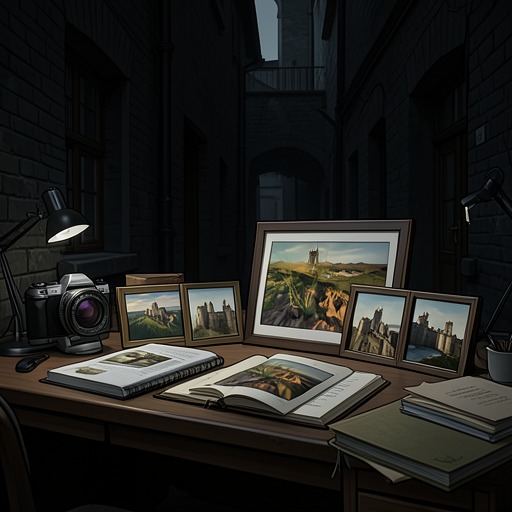
The boxing pictures should be distinguished from the photographs Rebus first finds in Ronnie’s room. That earlier portfolio includes views of Edinburgh Castle in mist and sunshine, along with posed photographs of a girl. The images hidden later in the library are different: copies of a boxing match, as Holmes recognizes when he finds them. The distinction matters because Rebus’s first discovery of Ronnie’s photographic work does not uncover the concealed material that later prompts his realization that people are seeking photographs.
The hidden set enters the investigation first as rumor. A young informant tells Rebus that word is circulating about photographs, specifically the real thing rather than fakes, though the talk has become vague as it passes from person to person. Rebus recalls this report when he connects the search for pictures to Ronnie. The recollection turns a loose rumor into a concrete lead, but at this point he still does not know where the photographs are or what they depict.
Concealment and intended use
Tracy eventually explains that Ronnie hid the photographs in the library. She says he described them as his life insurance policy, suggesting that he expected them to protect him or give him leverage, though she cannot explain exactly what was in them or how he intended to use them. She remembers the hiding place as the fifth floor, inside a bound volume of the Edinburgh Review. The precise location gives Holmes a practical search plan, while the phrase Ronnie used supplies the collection’s most consequential meaning: the photographs were not simply a record of a sporting event to him.
Holmes searches the bound volumes at the Edinburgh University Library, testing one after another by rocking them to see whether anything will fall free. Some years are missing from the collection, making the hiding place seem vulnerable to discovery. At last, photographs slide from among the pages and strike the polished floor with a sharp crack. Their glossy surfaces briefly suggest the promised revelation, but Holmes recognizes them as copies of the boxing-match pictures already seen. He finds no new prints or identifying evidence. Ronnie’s supposed insurance has survived concealment, yet the recovered images do not, on their own, explain what protection they were meant to provide.
Recovery and failed expectation
A separate package associated with Ronnie’s hidden photographs is recovered and opened by Rebus and Holmes. It has been wrapped in a red plastic bag, then cloth, sealed with extensive tape and tied with string. Rebus anticipates a discovery; when he opens the package, he finds only photographs of a boxing match. His reaction registers the distance between the lead’s promise and the object itself: the images appear to offer no obvious answer. Holmes suggests that someone significant might be visible among the spectators, but this remains a possibility rather than a finding.
Examining the prints more closely, Holmes notices how technically compromised they are. The boxers were photographed near the ring without a flash, using the smoky lights above it. The fighters and audience consequently remain grainy and indistinct, with movement blurring the action. In one image, an angled dark obstruction cuts into the right side of the frame. Holmes infers that the camera was concealed beneath a jacket: that would explain the obstruction, the awkward angles and the absence of a flash. The photographs therefore bear signs of deliberate covert capture, but the inference identifies a method, not the photographer’s target or the intended recipient of the pictures.
The photographs and the hidden club
The possibility of covert photography acquires weight when Rebus discovers Hyde’s Club, a concealed boxing venue beneath Finlay’s Club. The room contains a small ring and rows of chairs; Rebus understands that fights there involve vulnerable young men and that wealthy spectators can place bets. In this context, Ronnie’s boxing pictures may relate to a world where the powerful watch from safety while others perform violence for money and drugs. The text leaves open whether Ronnie had been paid to photograph influential people without their knowledge or had brought a hidden camera while present for another reason. Neither explanation is confirmed by the prints themselves.
The club’s hidden arrangement sharpens the photographs’ central ambiguity. Elsewhere, Rebus confronts the idea of people watching through a two-way mirror and a camera in a private room; the question of who observes, who is observed, and who controls the images extends beyond the boxing ring. Yet the connection between those surveillance practices and the pictures remains a question in the investigation, not a proven account of what Ronnie photographed. The images suggest that watching could be covert and potentially valuable, while their indistinct faces frustrate efforts to identify the people involved.
Narrative and evidentiary significance
The photographs repeatedly raise expectations and then withhold certainty. Rumor makes them sound like authentic, consequential evidence; Tracy’s account reveals that Ronnie hid them deliberately and considered them a safeguard. Their recovery confirms that they are real prints of a boxing match, and Holmes’s close inspection offers a plausible explanation for how they were taken. But the pictures do not provide clear identities or a self-explanatory account of their purpose. Even when Tracy reveals the precise hiding place, the discovery yields copies rather than a new revelation.
That gap between potential and proof makes the collection a useful image of the investigation itself. Photographs appear to preserve what happened, but these prints are obscured by poor light, movement, concealment and the absence of recognizable faces. They may have been intended as leverage, yet their value depends on information the images do not plainly disclose. Ronnie’s secret archive thus functions both as a clue and as a limit: it directs Rebus and Holmes toward hidden networks of spectatorship and power, while leaving the crucial interpretation unsettled.